
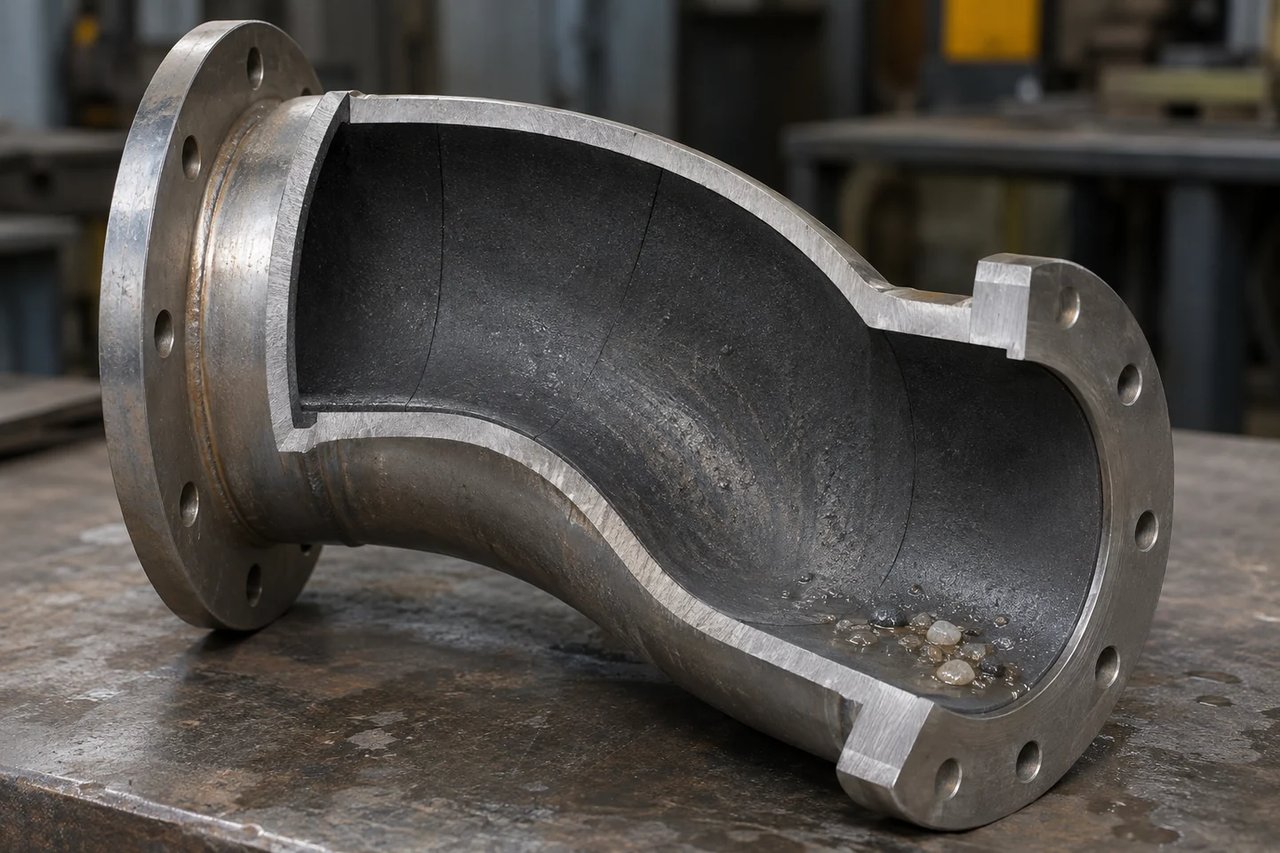
Consider silicon carbide (SiC) for a nozzle, wear plate or sleeve exposed to abrasive slurry. Inspect the failed part and its operating history first. Broad surface loss and chips at an unsupported edge point to different checks. Separate sliding abrasion, particle impact, chemical exposure and assembly damage before selecting a grade.
Which slurry conditions belong in the RFQ?
Provide the part number, drawing revision, installation orientation and photos of the failed part. State solids type, particle size range and concentration, including whether it is measured by mass or volume. Include liquid chemistry, temperature, normal and peak flow, cleaning media and abnormal conditions. Mark the flow-facing surface, critical fits, allowable edge geometry and finish on the drawing. Identify the functional bore on a nozzle or the shaft fit on a sleeve.
How should proposed SiC grades be compared?
Ask suppliers to identify the grade and manufacturing route. Verify a proposed sintered or reaction-bonded SiC grade against the actual liquid and temperature. Sand-water jet research on ceramics, including reaction-bonded SiC, examined the influence of solids concentration and impact angle. Use the relevant slurry and failure mode when comparing samples.
What should the sample trial measure?
Record the incumbent part’s condition, then agree on sample identification, critical dimensions, edge condition and inspection points. A slurry-abrasion test can help compare candidates in a given medium. Use a representative equipment trial to check geometry, assembly and actual flow. At matched intervals record an agreed measure, such as wall loss, bore growth or edge damage, and decide the rejection limit in advance.
Prepare your drawing
Send the drawing and operating conditions for a feasibility discussion. Use the material overview below to review the selection inputs.
Review silicon carbide material and application considerations