
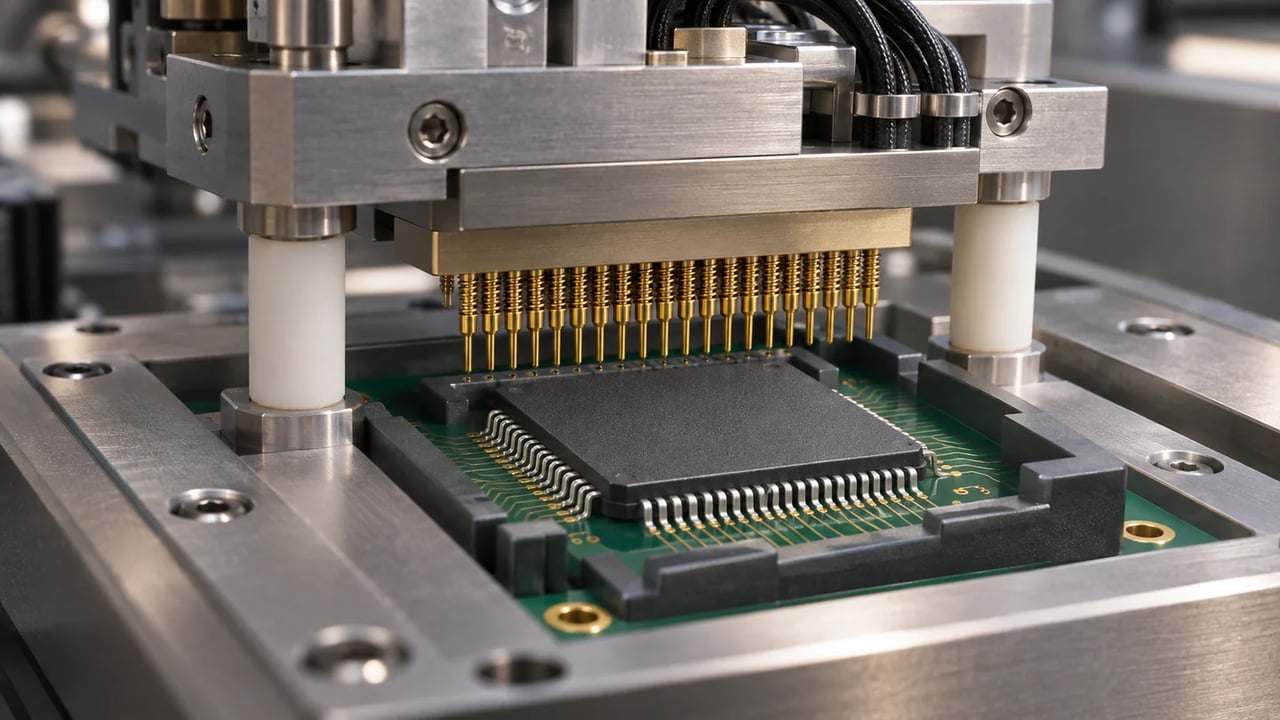
To qualify a custom ceramic part for semiconductor test equipment, define what it must do at the station, then agree on how the first article and installed sample will be tested. Start with the dominant risk: electrical leakage, wear and debris at a locating surface, or unstable temperature at a test fixture.
Why this matters for equipment teams in Penang and Kulim
The Malaysian Investment Development Authority identifies Penang and Kulim as hubs for semiconductor and industrial electronics activity. InvestPenang’s ATE Campus maps local equipment capabilities across test, inspection, handling and factory automation. Its October 2026 announcement of ESTEK’s new facility in Batu Kawan is a recent example of activity in the equipment cluster. The selection steps below are for teams specifying components for individual stations.
Match the ceramic to the job at the station
Electrical isolation near a test socket
Alumina is a starting point for a rigid insulating spacer or mount. Specify the working voltage, temperature, humidity, cleaning exposure and the distance between conductive surfaces. Agree on insulation or dielectric tests for the assembled geometry where required. A material datasheet alone cannot account for surface contamination or the metal mounting layout.
Repeated positioning in a handler or inspection station
Compare alumina and zirconia grades for guides, stops or locating pads. Record the mating material, contact load, stroke, speed and cycle count. Check positional drift, edge chipping and debris after cycling with the actual mating part. For a replacement part, note where the original failed and whether the guide sees impact or sliding contact.
Heat transfer with electrical isolation
Consider aluminum nitride (AlN) when a fixture needs to conduct heat while electrically isolating the test assembly. Specify temperature limits, ramp rates, contact flatness, thickness and clamping conditions. Check thermal performance in the stack and inspect the sample after cycling. Confirm the proposed grade against wear, high-temperature load, thermal shock and any cleaning chemistry before approving it for the station.
Agree on the acceptance checks before ordering
First article. Agree on the drawing revision, datums, inspection method and critical tolerances. Inspect locating features, contact surfaces and edges before the sample is mounted.
Installed sample. Test the part with its actual fasteners, mating surfaces and operating cycle. Define pass criteria for drift, wear or debris, electrical isolation, or temperature stability as applicable.
Repeat orders. Record the approved grade, finish and inspection criteria. Agree on what evidence is needed if the material, finish or manufacturing process changes.
Prepare a request for quotation
Describe the station, failure mode and operating conditions. Share the drawing revision, critical features and tolerances, mating materials, prototype and repeat quantities, and delivery destination. If the drawing is confidential, describe the problem first and agree on a way to share it securely.
See Jiwei’s Semiconductor Equipment Ceramic and Quartz Parts Procurement Guide or discuss a test-equipment part with Jiwei.
The examples illustrate how to plan qualification. Material grade, dimensions and pass criteria are confirmed for each application.